
The Solar Journey
Five years of Ward & Lisa Bowman's 13.43 kW rooftop solar and battery system: what broke, what Ace Residential Solar and SolarEdge each said about it, and why the answer eventually became “measure it yourself.”
Compiled from Ward's own contract, emails, and support cases, 2021–2026 · the direct origin of wattwhen · everyone below is named in full once, then abbreviated to initials — key at the bottom
Why we went solar
The interest predates the house. The budget and the reason didn't arrive until 2020 and 2021 — and by WB's own account, two separate decisions (heat pumps, then solar) came out of two separate conversations.
The idea didn't start with a sales call. In January 2017, working at GE Intelligent Platforms, WB drafted a private pilot proposal of his own — he called it “Predix Solar Project v1.1” — to monitor a solar installation on GE's Predix industrial platform. He'd already been running what he called “Predix in a box” at home: Raspberry Pi, Intel NUC, and Edison boards doing his own home-based monitoring, the same instinct wherewhen and wattwhen both descend from. That's where the want came from — solar generation and battery storage, monitored the way he was already monitoring everything else at home — four years before the Bowmans had the roof, the budget, or a reason to act on it.
The budget arrived through Mass Save. The Bowmans' first 0% HEAT Loan closed sometime in March 2020 — $17,000, a figure that only surfaces in the record two years later, when CLEAResult's Michael Polletta cited the program's $25,000-per-property combined cap while processing a second loan. By WB's own account, it was that direct conversation with Mass Save — not the solar shopping still to come — that settled the household on heat pumps. Some of that same work paid for an electrical upgrade: when Ace's own site inspector asked about the panel a year later, Dalio Electric's Thomas D'Alio confirmed it was already a 200-amp main lug.
Then COVID moved WB's desk into an unheated, uncooled basement. The Bowmans redid the space so he could work there year-round and added Mitsubishi mini-splits — by his own account, mid-2021. With the whole household home 24/7 and the majority of heating and cooling now running through those mini-splits instead of oil or gas, the electric bill climbed to around $400 a month. By WB's own math, financing the solar system would run close to $500 a month — close enough to what they were already handing the utility that, at that point, they figured they'd be paying themselves instead.
Batteries specifically were justified by outages, not just the bill. The 2011 “Snowtober” nor'easter — power out for the better part of a week across Worcester County, the same National Grid territory Mendon sits in (see “Why batteries” below) — was still fresh enough in memory that it shaped the decision on its own: without the well pump running, there's no water pressure, so no flushing toilets, and no air conditioning or heat either, whatever the season. Solar panels alone don't fix any of that — a grid-tied inverter shuts itself down the moment the grid does, for line-worker safety, same as every other home's. Batteries were the piece that actually kept the house livable through an outage; the panels just kept the electric bill down on a normal day.
The specific push to actually go solar, by WB's own account, was Solarize Mendon-Upton — the town's run of the state's Solarize Mass Plus program. Its “Ask the Experts” webinars, held April 8 and 13, 2021 (solarizemendonupton.com — the only URL on that site that still resolves), covered solar PV, battery storage, EVs, heat pumps, geothermal, and solar hot water. Mendon had already invested in its own municipal solar farm to offset the town's own energy costs — part of why the town ran the program at all. The Bowmans went with heat pumps and solar. Solarize's installer list is also the direct reason Ace ended up on the quote list: Ace's Nick Moore, Mar 2, 2021 — “Thanks for your time today, glad you found us through the Solarize program and reached out!”
Who else got a look
Six installers, one town program, five weeks — Feb 24 to Mar 31, 2021.
| Company | Contact | First contact | Outcome |
|---|---|---|---|
| Trinity Solar | Katherine Cardinal | Feb 24, 2021 | No-cost consultation confirmed for Mar 4, 2021, 5:00 PM. |
| All Energy Solar | Kevan Bohan | Feb 24, 2021 | Opened with a qualifying-questions email the same day. |
| Venture Solar | Ben Vest | Mar 3, 2021 | LG Platinum Pro dealer; quote appointment Mar 4, 2021, 1:00 PM. |
| Sunrun | Jared Gouvin | by Mar 4, 2021 | Follow-up meeting set for Mar 11, 2021 — WB cancelled it Mar 10: “we will be using another provider.” |
| Tesla | Zach Dorff | Mar 8, 2021 | Powerwall was the draw — the gold standard in storage at the time — but the website showed installs 3+ years out, with no confidence Tesla would even install in MA. Cancelled Mar 10. |
| Ace Residential Solar | Nick Moore → Corey Myrbeck → Kavin Shah | Mar 2, 2021 | “Glad you found us through the Solarize program.” The one WB signed with — Master Purchase Agreement, Mar 29–31, 2021. |
What set Ace apart, before anything went wrong
It wasn't just Tesla. By WB's own account, every installer on the list, Ace included, started out quoting the same way: standard 330W panels spread across both roof faces — south (rear) and north (front) — to maximize panel count, the front's poor exposure notwithstanding. Tesla's quote is the one that survives in writing, because WB put the question to them directly, Mar 8, 2021: “What size system do we get with just the panels on the back of the house only. As the front of the house is north facing.” Tesla's ZD answered the next day: pull the front panels and the rear-only array drops to 29 panels, 9.86kW — a real number on what the north roof was actually contributing.
What actually set Ace apart was being the first installer willing to accept larger-wattage panels — 395W LG modules instead of the 330W everyone else defaulted to — concentrated on the good, south-facing roof alone. It cost more per panel, but by WB's own math it cost less than the extra 330W panels a both-faces design would have needed on the marginal north side to make up the difference. The system spec below is the result: all 34 panels at 26° tilt, 174° azimuth — nearly due south. None on the north face at all.
Tesla stayed in the running longer than the panel math alone would explain, because of the battery: Powerwall was the name in home storage at the time, ahead of the LG RESU10 Ace was quoting. What killed it was Tesla's own website showing install dates more than three years out, with — by WB's own account — no real confidence Tesla would install in Massachusetts at all. WB cancelled Mar 10, 2021: “We are not looking for solar panels on the front of our house, and with the lower power generation would not offset the cost enough to justify... we will be working with other companies to do only the back side of the house with large capacity solar panels.”
An installer and a manufacturer can each have a perfectly reasonable story. The problem is when neither story is checked against the other, and the homeowner is the only one holding both.
What was quoted, and what got installed
The signed Master Purchase Agreement, the signed design page, and ACE Solar's own Aurora shading/irradiance report, next to solar_system_summary.md's later inventory of what's actually on the roof and in the garage — one table instead of two, so the two sides sit side by side.
| Item | Quoted — Mar 2021 contract | Installed — as of Aug 2026 |
|---|---|---|
| System size | 13.43 kW DC PV array | 13.43 kW DC total |
| Modules | (34) LG395Q1C-A6, 395 W | 34 × LG395Q1C-A6, 395 W each |
| Inverter | (1) SolarEdge SE7.6kW EnergyHub — 25-year warranty included, as contracted | SolarEdge SE7600H-USSNBBL14 Energy Hub, 7.6 kW AC (one string) |
| Optimizers | (34) SolarEdge P505 Power Optimizer — the contracted part number (Schedule A) | 34 × SolarEdge P401, one per module — a lower-tier part; see “What went wrong” below |
| Battery | (2) LG Chem RESU10 | 2 × LG RESU10H Prime, 9.6 kWh usable each — ~19.2 kWh nominal, ~10 kW combined discharge. Installed in the garage. |
| Monitor / racking / electrical / labor / permits | Included in scope, per the signed contract | — |
| Roof | — | 26° tilt, 174° azimuth — nearly due south |
| Energized | — | June 21, 2021 (SolarEdge site record, Site ID 2428857) |
| Programs | — | MA SMART SMANG_40299 · National Grid ConnectedSolutions storage rewards |
| Monitoring today | — | mySolarEdge / SolarEdge Monitoring — the ACE Solar owner app was discontinued Oct 2025 |
| Total price | $55,086.00 — $37,486 solar PV + $17,600 batteries | — |
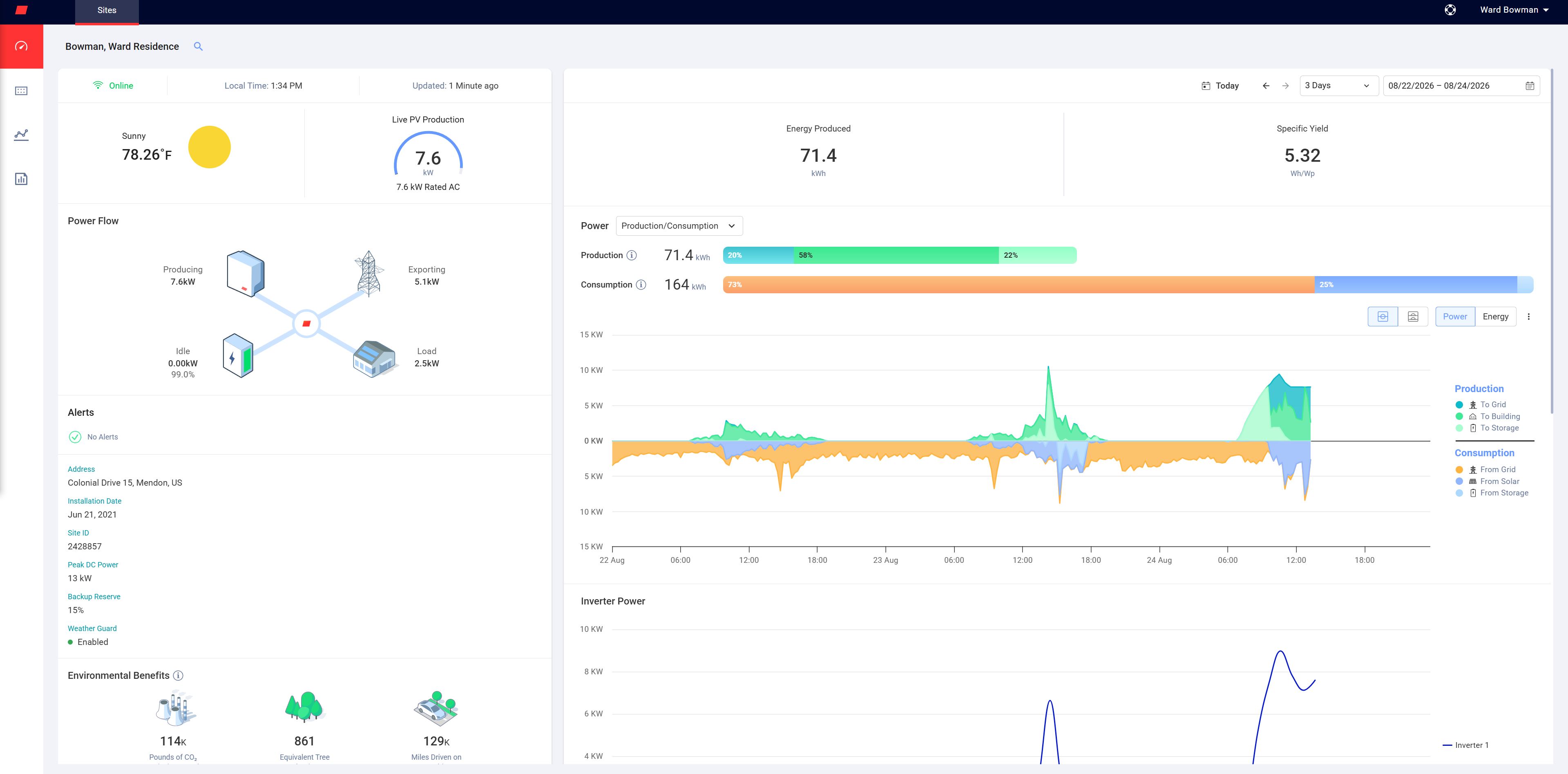
SolarEdge Monitoring, Aug 2026.
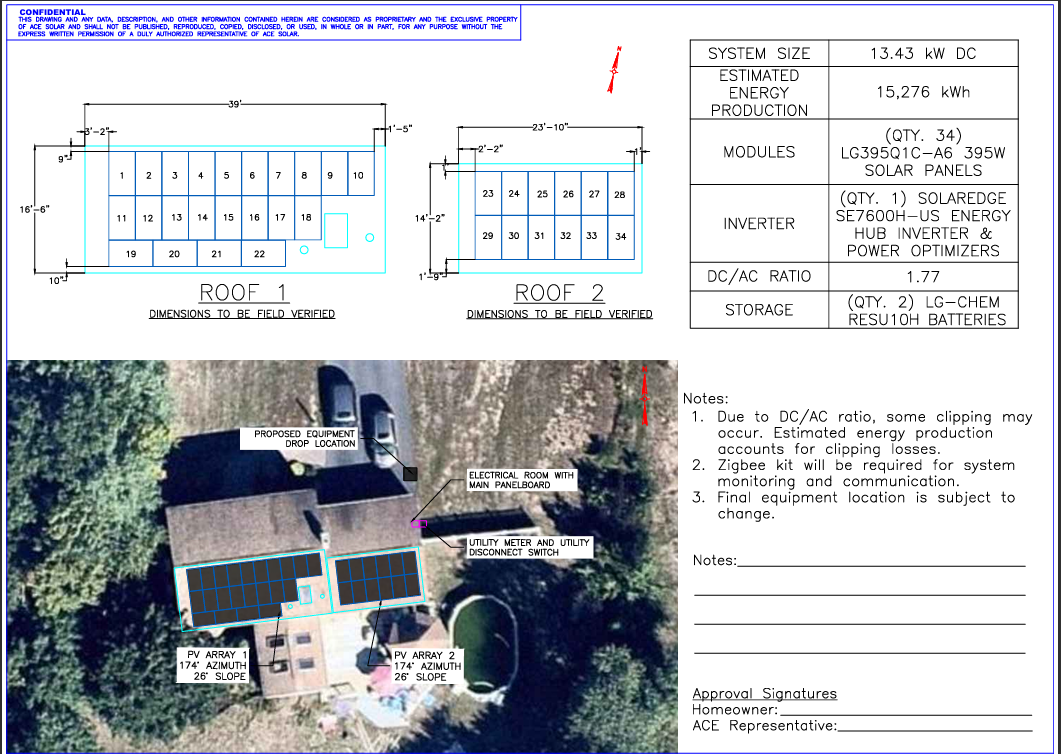
The signed design page — 15,276 kWh estimated annual production.
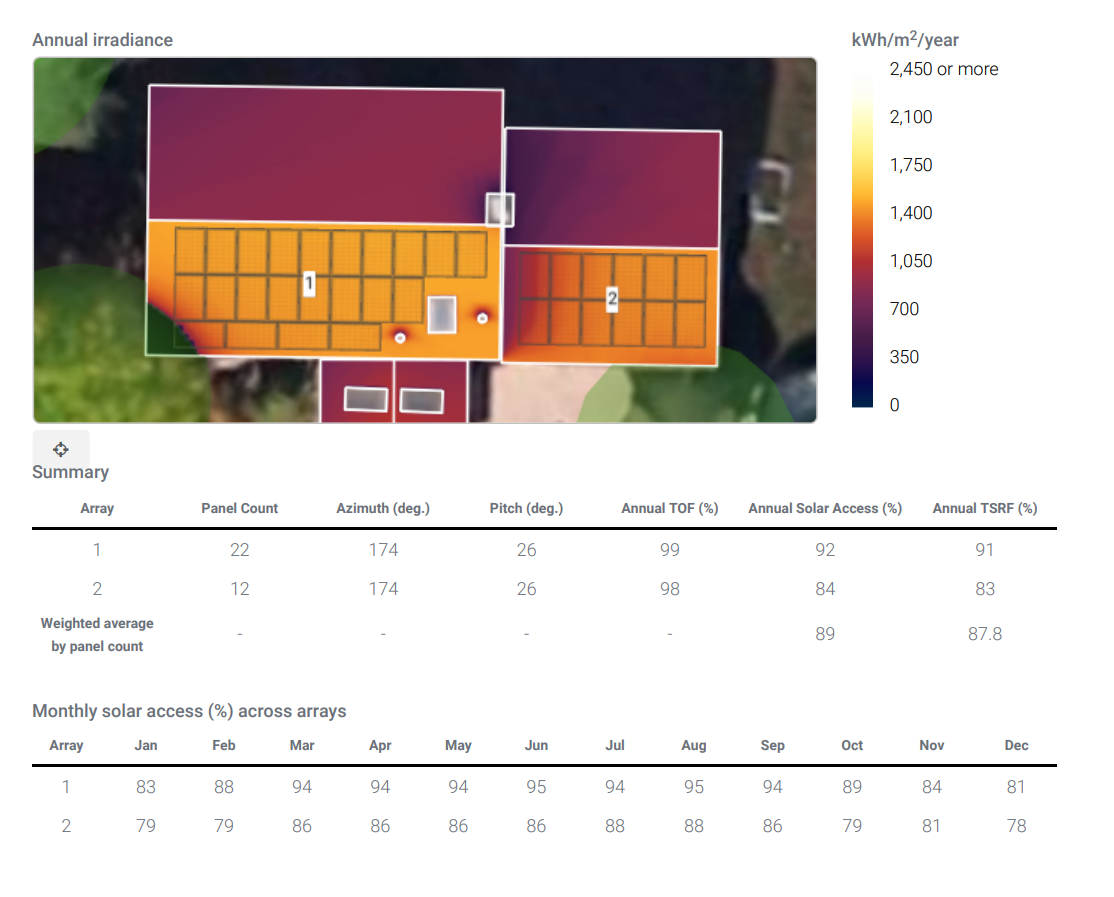
Aurora Shade Report, Apr 9 2021 — 92%/84% annual solar access, 87.8% weighted TSRF, ACE Solar's own signed certification. The one tree the report flagged near array 2 was later trimmed, then cut down entirely.
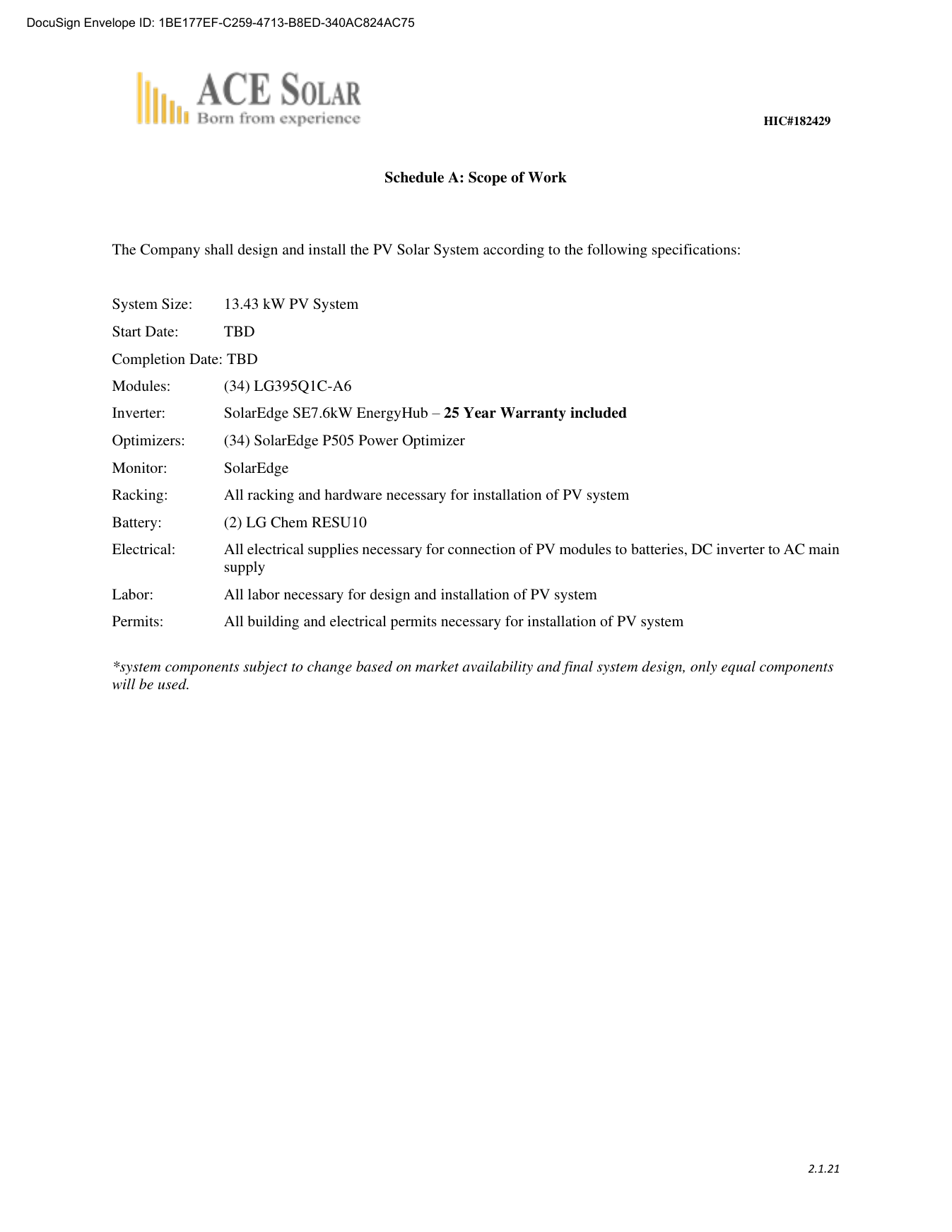
Schedule A of the signed contract — the P505 optimizer line, in Ace's own letterhead.
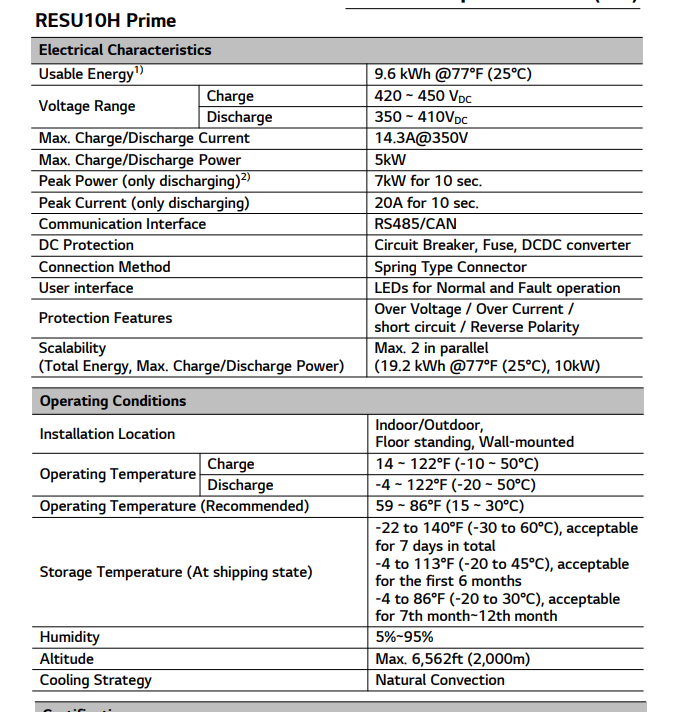
LG RESU10H Prime datasheet — the manufacturer's own recommended 59–86°F charge window, against a garage installation.
Contract to today
TimelineJS3 (Knight Lab) — use the arrows or scroll the strip below the dates.
$/kW means average kW, not peak kW
National Grid's ConnectedSolutions battery incentive isn't a flat payment for how many kW of battery sits in the garage — it's paid on the average kW the system actually delivered across the events it was dispatched for that season, not the battery's peak or nameplate rating. A battery that discharges hard for ten minutes and then drops out — which is exactly what Ace's inverter kept doing mid-event, see the timeline above — drags the average down, and the payment down with it, even though the hardware itself is rated far higher.
WB found this out running his own numbers, not from anything Ace or National Grid explained upfront. Emailing Ace's CM in May 2023 about how much he'd actually been paid: “Technically it is high as I have the $ per KW at 275 (Cell S30). The real rate is $225 which matches the payment I received of $203.” His own tracking spreadsheet's naive $/kW cell said $275; the number that actually matched a real payment was $225 — per average kW delivered across the season's events, not per kW of battery installed.
That's the same kind of number in the stat blocks below — 8.3 kW average delivered across 12 events in 2023, not the batteries' roughly 10 kW combined discharge rating. It's also exactly what wattwhen, this whole page's reason for existing, is built to track for itself: an independent, event-by-event read of what actually got delivered, instead of trusting a dashboard summary or waiting months for a utility's own true-up.
The other side of the ledger nobody puts a number on: when the batteries recharge from the grid instead of from solar — topping off ahead of a scheduled event, or overnight — that's paid-for electricity going back into the battery, not free sunlight, and it's a real cost against whatever ConnectedSolutions pays out. It stays invisible unless something is actually watching which source charged the battery each time — the same reason wattwhen cross-checks two independent meters instead of trusting either one alone.
How WB mapped the system himself
Ace's GM would later tell WB to stop watching his own system (see below). Months earlier, WB had already diagrammed how it was supposed to behave in every mode — this is that diagram, redrawn from his own notes.
| Mode | What's supposed to happen |
|---|---|
| Excess solar | Panels outproduce the house. The house is covered first, the surplus charges the batteries, and anything left over exports to the grid. |
| ConnectedSolutions event | The inverter holds maximum output to the grid; the batteries connect in to sustain that output — “the only time the batteries power the inverter,” per WB's own notes. |
| Solar below house load | The inverter covers what it can from solar. The sub (backup-loads) panel draws from the batteries through the BU inverter; the shortfall on the main panel comes from the grid. |
| No solar production (night) | Batteries power only the sub panel. The main panel always pulls from the grid — batteries never feed it outside a ConnectedSolutions event. |
| Grid outage | The main panel disconnects entirely. The sub panel keeps running on batteries through the BU inverter — basement circuits only: the well pump (so the toilets still flush and there's running water), the basement fridge, and the basement's own mini-split and oil heater, keeping that one space livable through a long outage. Everything else in the house goes dark. |
What ConnectedSolutions actually paid out
WB's own tally of the 2023 event season, from the same working file.
What a bad outage around here actually looks like
By WB's own accounting, batteries pay for themselves three ways: keeping the house running through an outage — not just a week-long disaster, but the far more common few-hours-to-a-day kind too — shifting evening and nighttime usage onto stored solar instead of the grid (see the scenario table above), and Connected Solutions event payments from National Grid (the “ConnectedSolutions math” section above). Outages are the hardest of the three to put hard evidence behind, and the one with the most riding on it.
National Grid's own outage map only shows what's happening right now — there's no public tool to look up outage history by address. These two are pulled from published storm coverage and the state's own emergency-management outage map instead, the closest public evidence of what the sub panel above is actually for.
| Oct 29–30, 2011 The “Snowtober” Halloween nor'easter | Central and Western Massachusetts — Worcester County, the same National Grid territory Mendon sits in — took the worst of it: a foot of unusually early, heavy snow on trees still in leaf. National Grid had roughly 116,000 customers out at the peak; nearly 44,000 (close to 40%) were still dark six days later, and Worcester city officials warned some outages could run past a week. This predates the Bowmans' own system by a decade — regional context for what “bad” looks like here, not something their batteries lived through. |
| Dec 18, 2023 A December nor'easter | Mendon is named specifically — one of the towns the Massachusetts Emergency Management Agency's own outage map showed with more than 10% of customers out, among the hardest-hit in the state. Statewide, over 260,000 customers lost power; National Grid was restoring roughly 20,000 customers a night and shifting crews to its hardest-hit towns for a multi-day restoration. This one falls squarely inside the Bowmans' ownership window — the same battery backup documented failing in “What went wrong” below was already two years installed by then. |
Which is also the honest caveat: the same battery backup was already installed for the Dec 2023 storm, and — as the rest of this page documents — it's the one job it's failed every time it's been asked to do. The value the batteries were sold on is real; whether this particular install ever delivered it is a separate question.
22 problems, most of them found by WB first
In the order they're easiest to explain, not necessarily the order they happened — the full sequence is in the timeline above.
Contracted equipment quietly downgraded
The signed Schedule A specifies (34) SolarEdge P505 Power Optimizers. What's on the roof, per solar_system_summary.md's later inventory, is 34 SolarEdge P401 — a lower-tier part. Nothing in the record shows WB was ever told about, or agreed to, that substitution.
A 20-year installation warranty, deflected in one email
Section 7 of the Master Purchase Agreement: Ace "shall also resolve any system-related problems caused by improper installation for a period of 20 years at the Company's sole expense." On July 25, 2023 — three months after a SolarEdge tech found undersized wire, a disconnected wire, and batteries wired in the wrong order — Ace's GM called the same defects "manufacturing issues out of our control" and pointed WB at SolarEdge and LG instead.
Installed in an unconditioned garage, not the basement WB asked for
“The batteries were suppose to be installed in the basement, but the installer chose to do the garage,” WB wrote March 6, 2023, after KS attributed the 1.9 kW charge cap to battery temperature. WB bought a wireless thermostat that afternoon and measured 46–56°F in the garage — not exotic winter cold. He measured it again April 14: “the system needs 60' F to charge at full rate. But it is 47.1' F in my garage right now.”
Wiring found wrong, months after install
A SolarEdge technician's April 10, 2023 site visit "verified that there were some installation issues (smaller gauge wires, wires not connected, batteries configured in the wrong order)." This was reported and re-reported from September 2022 on before anyone confirmed it in person.
A firmware push broke CT/data reporting
An Ace technician's on-site firmware update in April 2023 overwrote SolarEdge's firmware. CT (current transformer) data went backward for weeks — "it seems to be counting everything that goes to the house going to the grid, and double counting consumption."
Batteries capped near 1.9 kW charging — worse than even the design predicted
WB's own pre-install notes worked the RESU10 switchover ceiling out at about 1.93 kW combined. What he found in the field, reported Feb 22, 2023, was that cap holding *all the time* — 9+ kW of solar production, the house drawing 1.4 kW, and the batteries still taking only ~1.9 kW while the rest spilled to the grid — not the occasional switchover dip his own diagram expected.
The GM misexplained his own company's system design
March 27, 2023 — Ace's General Manager told WB the batteries were limited by the 7.6 kW inverter ("Your invert is only 7.6 kw. The system was a little over size due to the battery but that does not mean it has extra capacity to charge the battery"). The batteries are DC-coupled — they charge before the inverter, bypassing that limit entirely, exactly as Ace's own sales manager explained elsewhere ("Because the batteries charge from DC power, we want to oversize the DC"). Same company, two incompatible explanations of the same hardware.
Undisclosed 50% capacity limit, admitted after the fact
Same email, same day: "a 10kw battery can only use 50% of its storage so it only has 5kw capability... This was not explained to you." WB's own math (25%+25% of two batteries = 50% displayed, not "very little power") went uncorrected in that thread.
Battery profile silently set to "Backup only"
March 7, 2023 — SolarEdge support: that setting "will only discharge if the power goes out." WB had been told the system ran Maximize Self-Consumption; only the installer can change the profile, and nobody had told him it had changed.
Two extended battery outages — the second right as the battery warranty lapsed
The first outage ran roughly May–September 2022 (per WB's own April 2023 recap: "the batteries failed from May until Sept of 2022"). The second began Feb 16, 2023 — about a year after the Feb 2022 install, just past the contract's 1-year battery-installation warranty (Section 7), versus 20 years for the rest of the system.
A third of the array sat disconnected for 8+ months
One of three panel strings was left unconnected from the June 2021 install until the February 2022 battery install, over inverter-oversizing limits Ace's own team later called uncertain: "I'm not entirely sure when/why things changed on that."
Told to monitor it, then told to stop
The signed contract puts monitoring on the client: "the Client is responsible for monitoring the system and the Company will not be responsible for any losses due to unreported outages." Ace also confirmed in writing (May 31, 2022): "We do not monitor the system for you." On April 17, 2023, Ace's GM told WB to do the opposite of what his own contract required: "Delete that app."
Support channels went dark
April 20, 2023 — Ace's own operations-and-maintenance voicemail box was "full for about 2 weeks" while three open issues sat formally reported and unacknowledged. In WB's own words, from a Facebook review: "6 weeks is 'normal' time frames for responses."
Two of five incentive years lost
MA SMART pays out over 5 years. By September 2023, the system had been down or misconfigured for two of them: "2/5 of the payback has been lost."
The installer's own residential support wound down
October 2025 — Ace's Residential department closed and the ACE Solar owner app was discontinued. Owners were told, going forward, it's "the system owner's responsibility to monitor their solar system."
The one job backup power has — it failed every time
Battery backup for the basement during a grid outage was one of the four things WB listed as what he was sold. His May 2023 review: "The system has failed during 100% of the power outages this year."
Ace's own installers said other battery customers had the same problems
Same review: "Note the other system they installed with batteries, had multiple issues. Their installers repeatedly told me how the other customers were frustrated." Not a one-off bad install, by Ace's own field staff.
Admin access requested in May 2023, still withheld in 2024
WB asked CM and KS for access to set his own battery charging profiles by season — a documented SolarEdge feature. By his July 2024 review, that access was still withheld: "charging profiles for your batteries should be a customer-settable feature, but Ace Solar withholds that from the customer."
Told the BBB it had responded — it hadn't
By April 2025, WB's own review: "ACE has not responded to the Mass AG's request for an update, or my request that they submit the paperwork. But they did close the BBB request as ‘responded.’ They never responded but they told the BBB they did."
$750 to diagnose equipment they sourced and installed
The same April 2025 review: Ace, having given up residential installs, now wants "$750 to come out and diagnose why the batteries they sourced, and installed stopped working."
The case bounced between reps before anyone actually looked
Feb 27, 2023 — Ace's MF said he was "waiting on their analysis" from SolarEdge; days later, with no update, WB escalated to KS directly. The same week, on a SolarEdge support chat, agent GN was more direct than Ace ever was: "We can't change that setting for you... due to grid services being active." The actual cause sat with a SolarEdge support agent the whole time, not the two Ace reps WB was cycling through.
Nine Connected Solutions events in 2023, and the inverter failed every one
WB pulled SolarEdge's own data event by event — Jul 3, 5, 6, 7, 8, 11, and 29 — and each one shows the inverter cutting out roughly 45 minutes in, or the system pulling power from the grid mid-event instead of discharging the battery. Not a one-off: a full season of it, documented from the source data, not from Ace's dashboard summary.
What Ace and SolarEdge said, next to each other
Every quote below is verbatim from the email or support-case record, with the speaker's initials, role, and the date — full names are in the "Who's who" key at the foot of the page. Nothing is paraphrased.
Told he might be unfixable — then told it's running great
Four months apart: privately, WB is told he may just be one of the unfixable ones; publicly and in writing to the Attorney General's office, the story is that everything works.
“We have no faults” — two weeks before Ace's own tech found real ones
Two weeks later, on April 10, a SolarEdge technician found undersized wire, a disconnected wire, and batteries wired in the wrong order — the on-site visit Ace was, in this same thread, refusing to schedule any faster. Ace then went and replaced the wire and reconfigured the battery communications — the repairs themselves are an admission the wiring was wrong, whatever the emails kept saying. As WB put it in a Facebook review: “It is never Ace Solar's fault, even when they have replaced wires, or correctly configure the battery communications.”
The GM explains the hardware one way; the sales manager explains it another
The batteries are DC-coupled — they charge before the AC inverter, not limited by its 7.6 kW ceiling. CM's explanation matches the design; the GM's doesn't, and nobody at Ace ever reconciled the two for WB.
“Working fine” and “manufacturing issues out of our control” — three months apart, same person
Between those two messages sits the April 10, 2023 SolarEdge site visit that found undersized wire, a disconnected wire, and batteries wired in the wrong order — installation findings, not manufacturing ones.
Installer says it's the manufacturer's problem; manufacturer says only the installer can fix it
Two vendors, two closed doors — for over a year, every open question bounced between them with WB relaying each side's answer to the other.
Ace's own sales manager named the pattern, in writing
Said the same day Ace tied a reimbursement check to WB taking down his reviews — see the settlement section below.
A verbal deal that got harder once the reviews piled up
The original deal, weeks earlier, was just: take the reviews down, get the check. Once it went unpaid past the promised date and WB posted two more reviews out of frustration, Ace came back requiring a signed permanent non-disparagement and confidentiality clause to release the same $1,375 — eleven months before the same pattern returned at nearly double the price, see “The settlement Ace offered” below.
“Installed to specifications” — a specification Ace itself signed and then didn't deliver
The equipment on the roof by the time of solar_system_summary.md was the cheaper P401, not the contracted P505 — “to specifications” isn't the same specification WB signed for.
The oversizing was “for the batteries” — until the batteries became the problem
Same email, two justifications for the same number. When WB asked the direct question — “Wouldn't the system be better off without the batteries and 10.5 KW inverter... Same panels, $16k cheaper” — the answer shifted from “for your batteries” to “everyone oversizes regardless of batteries,” which makes the original batteries-justify-it framing unfalsifiable and never actually answers what the batteries were worth.
“Negotiating the financial part of this settlement” — then just a free inverter, no payment
The financial settlement BK said he'd have “early next week” on Jul 11 had, by Jul 18, become conditional on a SolarEdge diagnosis that hadn't happened yet. The record shows only a free inverter after that — no payment.
Three offers, eleven months end to end
Two tied a payment to WB's silence; the one in between tied it to Ace exiting the batteries specifically. The last, sent by Ace's counsel, is the “Mutual General Release Agreement” dated January 18, 2024.
| Offer | Amount | Framed as | Conditions |
|---|---|---|---|
| Feb 24, 2023 offer | $1,375 | Reimbursement for lost ConnectedSolutions revenue “due to manufacturer defective equipment” | Confidentiality of the agreement itself, plus a permanent non-disparagement clause covering “reviews or social media post current or future.” |
| May 4, 2023 meeting | Unpriced — batteries only | A call with Ace's managing partners (scheduled via Google Meet invite; per WB's own account, not a written offer): Ace proposes buying back just the batteries and walking away. | WB counters with a full-system buyback instead. Ace declines. |
| Jan 18, 2024 offer | $2,750 | Full and mutual release of all claims “from the beginning of time through the date of this Agreement” | Delete all social media/media posts identifying Ace within 48 hours; withdraw the AG and BBB complaints within 48 hours; never post a future review; permanent non-disparagement covering Ace and “any of its affiliates or current or former officers, directors, shareholders, employees or agents.” |
If the panels and inverter were as trouble-free as Ace's GM would claim two months later — “the system has been running great” — a full-system buyback should have been the easier offer to take, not the one Ace's managing partners turned down.
Aug 2026
The inverter Ace scheduled in July 2023 is in. Ace's Residential division closed in 2025 and its owner app is gone; SolarEdge's mySolarEdge is the primary manufacturer channel now, kept alive by a $47.80 cellular-plan renewal in July 2026. The system runs, but for five years the only account of whether it was running well belonged to whichever vendor answered the phone that week. wattwhen exists so that stops being true — SolarEdge's numbers cross-checked against an independent Emporia meter on the same interconnection, not one company's word taken on faith.
Every name on this page, in full
Names are abbreviated to initials throughout — the three that come up most: GM: MC (Michael Champagne), Sales: CM (Corey Myrbeck), Owner: WB (Ward Bowman). Full list below, grouped by side, with each person's own title from the record.
Homeowners
| WB | Ward Bowman | System owner — every unattributed “he/his” on this page is WB |
| LB | Lisa Bowman | WB's wife; co-signed the 2021 Master Purchase Agreement |
Before Ace — shopping around, 2020–2021
| MP | Michael Polletta | CLEAResult — administers the Mass Save HEAT Loan Program |
| TD | Thomas D'Alio | Owner, Dalio Electric — upgraded the home's panel to 200A |
| KC | Katherine Cardinal | Appointment Coordination Team, Trinity Solar |
| KB | Kevan Bohan | Sales, All Energy Solar |
| BV | Ben Vest | Residential Solar Advisor, Venture Solar |
| JG | Jared Gouvin | Sales Consultant, Sunrun |
| ZD | Zach Dorff | Project Advisor, Tesla |
Ace Residential Solar / Alliance Clean Energy
| NM | Nick Moore | Sales — first point of contact, Mar 2021 |
| MC | Michael Champagne | General Manager — joined Ace roughly 6 weeks before Mar 11, 2023, by his own account |
| CM | Corey Myrbeck | Sales Manager, Commercial & Residential — present at the original sale |
| KS | Kavin Shah | PV Engineer (2021) → Residential Solar Team Lead (2023) — WB's longest-running direct contact |
| MF | Michael Fortier | Case/O&M coordination |
| BK | Bob Kiley | Managing Partner, Alliance Clean Energy (Ace's parent company) |
| EM | Eric McLean, P.E. | Director of Operations |
| MK | Mark Kiley | Signed the 2021 Master Purchase Agreement for Ace |
SolarEdge
| TS | Troy Smith | Support |
| OC | Oren Cook | Field Service Engineer — WB's main SolarEdge contact from Aug 2023 on |
| GN | Georgi N. | Support (chat) |
LG Energy Solution
| AK | Andrew Kelley | cc'd on SolarEdge/Ace escalations regarding the LG batteries |
Regulatory / consumer advocacy
| RS | Robin Schwartz | Program Manager, Worcester Consumer Rights Program — the office that actually took WB's case, working in cooperation with the MA Attorney General's Office (Ace never dealt with the AG's office directly) |